Rants and Raves
In this section: the good and bad - on products and what's happening in the industry....
tips and techniques...
Jump to: Firearms and Equipment Recommendations
Click on Rants and Raves articles below
Cost-effective .22 conversions & dedicated .22 AR-15s
Smith & Wesson's M&P .22 semiauto pistol - a winner
Price, Perception, Practicality: a sensible look at guns
Left-side bolt handle AK conversion; not a good idea
S&W SD9 - budget defense handgun. Pros and cons.
Taurus Judge - why a simple .38 revolver is more sensible for defense
S&W Governor - still not ultimate / Prices of S&W Scandium Revolvers
Ruger's Light Compact Revolver (LCR) - a winner
S&W Bodyguard 38 Revolver - a disappointment
S&W Bodyguard 380 Pistol - a winner
Kahr Pistol Recurring Trigger Bar Problems
Colt AR-15s: Solid Investments 1980s-now
Forge Symbols and Markings on AR-15s
Beretta Model 92s: M9, 92A1, 92FS, M9A1
Industry - Sig Stupidity continues
Kimber Super Carry Pro vs CZ Bobtail Valor
Two mags should be the minimum standard
Sig and HK P30 Decocking Levers
Springfield XDs & XD-Ms vs. Glock
Efficiency of Ammunition/Packaging
Stopping Power and Caliber Debate
Abuse Tests of some AK magazines
Increasing QC Issues with Century GP/WASRs
Gas Piston Rifles and truth on Carbon Fouling
Costly Rifles: FN SCAR and Bushmaster ACR
>> Why Fight It? Standards and proven guns that make sense <<
Best defensive firearm category that the majority of people can use: Handgun
Firearm retention/controllability/portability is unequalled for handguns versus rifles or shotguns.
Best caliber selection for the masses in a defensive handgun: 9mm
Ideal balance of power, controllability and availability anywhere in the country or around the world.
Respectable power and capacity when kept in perspective. Shoot the threat and make hits count.
Peripheral hit with larger caliber is still a peripheral hit. Ventilate vitals and body functions will fail.
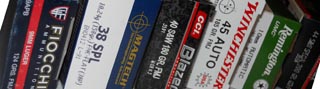
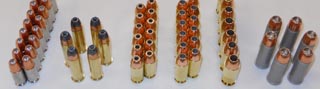
Best type of handgun choice between revolver or semiauto pistol: Semiauto pistol
Any awkward position/attitude of body = difficult and much slower to keep a revolver up and running.
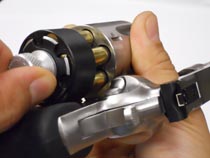
Loading/reloading revolvers is gravity dependent and will demand a smooth ability most will never achieve.
On the ground, upside down, one handed? Semiauto pistol much easier: insert mag, run slide. Gun is loaded.
Best operating system / simplest manual of arms in a semiauto pistol: Glock
Proven track record. Insert mag, run slide. Gun is loaded. Reload? Remove mag, insert mag, run slide.
No control levers to lower hammer; no external hammer. No manual safeties to engage or disengage.
No two different trigger pull distances or weights, no sharp edges or protrusions anywhere on gun.
Second category of defensive firearm that majority of people can learn quick and use: Semiauto rifle
Fantasize about the lever guns, slide action rifles, even idolize single shots - just use a semiauto rifle.
Ideally, use a proven military semiauto rifle, lightweight and proven in something as ugly as war.
Over-stated shotgun expectation/dependency misses facts just on system weight and system length;
tough for many who are of lesser upper body strength and weren't truthfully comfortable with guns.
Best caliber selection for varied situations in a military semiauto rifle: .223 or 7.62x39
.223cal (5.56mm) or 7.62x39mm are available and power/controllability/cost ratio is very good.
Prudently utilizing hollow or soft point bullets make the best sense in a variety of surroundings.
Due to projectile speed, these will mash, flatten, break apart and slow down faster than handgun calibers
fired from handguns or carbines. .223 (5.56) or 7.62x39 disrupts what needs to be disrupted very well.
.308cal (7.62mm) has tremendous power; choosing .308 in populated areas is simply irresponsible.
Characteristics of .308 in recoil management/muzzle blast/overpenetration energy: excessive on all points.
Easiest taught/learned/utilized system for the majority of people: Kalashnikov
Military magazine-fed semiauto rifle unaminously respected, proven, loved and feared worldwide.
Loading: Take safety off, lock in mag, run bolt. Gun is loaded.
Reload? Ensure safety is off, remove mag, lock in mag, run bolt.
There is no bolt catch function on last round. No need to teach/learn ways to release bolt.
No one-side or both-side mag release. Already ambidextrous release at front of trigger guard.
No way to emergency load with safety habitually engaged. No forgetting to take safety off again.

Third category of defensive firearm that fewer people can wield and operate easily: Pump shotgun
Shotgun's power/controllability/system weight/system length/capacity is not in balance at all.
Any awkward position/attitude of body = extreme difficulties keeping a shotgun up and running.
On the ground, upside down, one handed? Far tougher to load or top off vs semiauto rifle.
Loading and keeping shotgun topped off while maintaining firing grip to maintain readiness
requires more strength and well-rehearsed ability than lighter, quicker pistol or semiauto rifle.
If insisted, pump shotguns are simpler to operate and are less costly than semiauto shotguns.
Easiest taught/learned/utilized shotgun system whether from left or right side: Mossberg 500
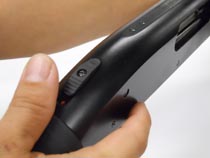
Controls: Safety is top rear of receiver. Whether right or left handed, firing hand thumb accesses safety.
Action Bar Release rear of trigger guard. Whether right or left handed, firing hand middle accesses release.
Sadly, too many in the US will never require themselves to be fluidly capable both left and right side.
For any system - handgun / rifle / shotgun - everyone should be unconsciously ambidextrous in highest stress.
That mandates A LOT more genuine training than what's accepted by the majority of firearm owners out there.

Most versatile choice for hunting rifle or 'larger-than-22cal' target shooting rifle: Bolt Action rifle
Consider comparing all makes of lever, pump, single shot, semiauto rifles in their common calibers -
consider ease of loading, unloading, common caliber-per-system usable range, rifle cost, optic usage.
Best continuing choice of bolt action rifle system and manufacturer: Remington 700
Sales reps and consumers will forever argue brands- Browning, FN, Marlin, Mossberg, Ruger, Savage, Tikka,
Winchester, Weatherby, etc... Remington has been and will continue to be most popular for numerous reasons.
Why? Remington rightfully has the well-earned popularity with brand recognition and successful track record.
Just get a Remington, quality steel bases and rings, a proven brand and model of scope and move on.

Best continuing choice of scope manufacturer: Leupold
Just like Remington rifles, Leupold optics have an ongoing success and will continue to do so.
Unconditional warranty, longest proven track record. Cost, quality and value ratio unequalled.
Most versatile caliber for hunting most game across the US: .30-06
Most logical and efficient caliber for mid-to-long range target shooting: .308
Either caliber has varieties of full metal jacket, soft point or hollow point ammunition available.
.30-06 has wide range of bullet weights for the hunting task at hand (animal, distance).
.308 available in many price brackets and performance levels to suit recognized needs.
More affordable for target shooting or introducing rifles to new shooters: .223 or .22 long rifle
If calculating .308 may cost too much (no suprise; even reloading costs money) for target shooting,
just get bolt rifle in .223 and/or truly enjoy one in .22 long rifle: less cost + less recoil = more new shooters.
Among .308s, Savage makes superb, affordable bolt rifles in .223 or .22 like the new MK-II TR shown below.
For optics, Simmons scopes are solid, cost-effective performers with .223 and .22 caliber bolt or semiauto rifles.

Savage MK-II TR, Weaver rings, Simmons 4-12x40 side focus adj.obj. scope, Butler Creek flip-up caps: $600

Fun begins... testing various manufactured pseudo-match / match .22 ammunition and finding what groups well.
Adjustable objective knob as side focus dial is a huge advantage in making shots on targets 50 yards and in.

Perspective of 50 yard distances at Koko Head. Most scopes on the market have parallax set at 70+ yards.
Important note: without adjustable objectives, crosshairs cannot be focused crisp on targets 50 yards or closer.
That's why adjustable objective scopes are recommended for target, either front ring or center turret adjustable.

Perspective of 100 yard distance at Koko Head. More concentration is needed to shoot good groups this far.
With a typical 8-inch drop for high velocity .22 ammo (more for standard or match .22!) plus effects of wind,
it's a good challenge for the shooter to keep groups consistent and know how to dial in different ammo types.
A good rifle, quality scope and ammunition is the other half of the formula. Savage MK-II .22 rifle delivers.
Simmons 4-12x is a cost-effective scope. Just about any .22 shoots well in this rig. Blazer .22 was consistent!
.22 caliber fun

All guns pictured above are chambered in .22 long rifle. Just can't go wrong with .22!!
L to R: AR with .22 conversion, Ruger MKIII, Henry levergun, Henry Mares Leg (classified as handgun),
Ruger MKIII with Trijicon RMR, Ruger 10/22, Browning Buckmark, Umarex HKMP5.22

Fun with .22s on the Silhouette Club Range at Koko Head Shooting Complex...
Cost-effective .22 conversions for AR-15s or dedicated .22 AR-15 replicas
Here are some I've been running thru some torture testing (various bullet profiles, standard + high velocity .22)
The goal is to fire at least 1000 rounds mixed ammuntion in each system over a period of 1 to 3 months without
cleaning .22 bolt/carrier, chamber, barrel or magazines - looking for flawless operation excepting bad ammo.


Trying many varieties of .22 caliber ammunition is extremely important - find what feeds reliably, what doesn't.
Common sense value - if a semiauto .22 (handgun or rifle) doesn't feed majority of ammo on the market,
don't buy it! A reliable semiauto .22 is a huge advantage. It should feed lead, copper plated, round nose,
hollow point, truncated cone, stepped shoulder .22 ammo. Ideally, it also should run standard or high velocity.
All .22 ammo is inherently 'dirty'. Lead ammo isn't "bad". Copper plated ammo 'shaves/flakes' leaving behind
malfunction-inducing bits of copper right in the action and entrance to chamber. I personally run Blazer .22 in
all my .22 firearms and that has been the most consistent out of all economy .22 brands for over 15 years.
Your choice of .22 caliber firearms - whether for fun, teaching or sharing - should feed all kinds of .22!
.22 Conversion Bolt for existing AR-15 in .223

Pic center: CMMG .22 bolt. Remove standard .223 bolt/carrier, replace with .22 conversion bolt/carrier unit.
(Want to go back to .223 caliber? remove .22 conversion unit, clean chamber, replace .223 bolt and carrier.)
Same weight as standard .223 AR-15. Red follower of magazine acts as bolt hold open upon firing last round.
Bolt catch isn't usable as a conventional AR-15. Loading / reloading - upon seating mag, run charging handle.
CMMG .22 bolt conversion w/ one 26 round magazine, $200. Spare mags, $25. Works with most .223 ARs.
Their magazines are solid; no openings to allow entry of debris and has shortest height while having capacity.
*New (more pricey) conversion bolt system has a functioning bolt catch - yet requires a different magazine.
That set is about $300 and mags are $30. Whether one has a 'spare' complete lower or not, costs add up.
With added considerations of a $250 complete lower, dedicated .22 AR rifles begin to look even better.*
Umarex HK 416D dedicated .22 AR-15 replica

Umarex HK 416D .22 - a reliable dedicated .22, no ability to change upper to any caliber larger than .22lr.
They have all metal upper, lower receiver, railed forend and buttstock tube. Has weight of standard AR-15.
Although lower is metal, cannot interchange with .223 upper assemblies. Buttstock tube and rail is very solid.
Bolt catch is not functional. On last shot, internal bolt catch activates, reload and run charging handle.
With one 20rd mag, this all metal .22 replica of HK's 416 AR variant is $599. Spare mags: $35.
Solid mag like CMMG; halves screwed together. However, slot on sides of mag allows entry of debris.
S&W M&P 15-22 dedicated .22 AR-15 replica

S&W M&P 15-22. Dedicated .22 rifle, no ability to change upper receiver to go larger than .22 caliber.
Upper, lower receiver, railed forend and buttstock assembly is some form of plastic. Almost too light.
Since lower is plastic, cannot use standard .223 upper assemblies. Buttstock tube somewhat fragile.
Bolt catch on this rifle is functional and duplicates exactly how the standard AR-15 system functions.
That aspect makes it the best choice for a lightweight dedicated .22 caliber AR-15 type teaching rifle.
Since it's lightweight, it is most advantageous for teaching and building up new shooters of all ages.
For best answers; lighter better than heavier. Dedicated better than conversions / switching uppers.
With one 25rd mag, Magpul MOE stock, pistol grip and sights as pictured above, $575.
With one 25rd mag, standard stock, pistol grip and fixed sights as seen above, $495.
Spare 25rd mags only $19. Unfortunately, slot on sides of mag allows entry of debris.

Pro of the M&P 15-22 magazine is low price. Con of the mag is how cartridges can hang up in magazine
when loading up mags. Hangups occured several times during firing sequences; regardless of bullet type.
As seen in pics above, cartridge rim can hang up on a small ridge inside magazine feed track, preventing
the .22 cartridge from being properly up high enough right at feed lips to be chambered during firing cycle.
As usual, it's a magazine (design) issue; not gun itself - whether clean/dirty, or bolt/feedway/chamber issue.
Still functioning and cycling reliably...
S&W M&P 15-22 approximately 700 rounds Umarex HK 416D approximately 900 rounds


M&P15-22 has removable bolt, charging handle. Umarex HK416D doesn't require any parts removal.
Carboned and dirty, will fire these two rifles with all types of .22 ammo until they repeatedly malfunction
from carbon fouling and particle clogging. We'll see how long they can go before cleaning. Then, repeat.
12/06/10 : S&W M&P15-22 now at 900 rounds. Now it is at same round count as Umarex HK 416D.
01/30/11: Both are at approximately 1,200 rounds. Both are even dirtier, yet still running great! Only few
malfunctions (failures to cycle bolt fully) were noticably weak .22 loads inevitable in such volume testing.
02/19/11: More ammunition thru M&P15-22, now at approximately 1,400 rounds. Amazingly reliable!
Also started firing tests of a very new Umarex HK MP5 copy seen in background of the picture below.

S&W M&P 15-22 advantages: incredibly reliable and very lightweight so more can learn AR-15 systems.
Below are continuing picture series of both test rifles still going strong after 1500 rounds without cleaning!
S&W M&P 15-22 approximately 1600 rounds Umarex HK 416D approximately 1800 rounds


04/30/11: the S&W M&P15-22 and Umarex HK416 22 are going and going... awesome reliability!
05/08/11: S&W M&P15-22 rifle is still firing so reliably that I added another to the testing rifles lineup.
The extended test Umarex HK416 has sold to an enthusiastic customer who loved the proven reliability.
06/28/11: after Shooting Sports Fair 2011, both M&P 15-22 rifles have fired over 2,000 rounds each.
Umarex HK MP5 dedicated .22 MP5/HK94 replica

HK MP5 .22 w/ Knight's Armament Corporation fake suppressor shown above. SD version shown below.

Umarex has introduced a .22 caliber officially licensed copy of Heckler & Koch's MP5 submachine gun
that seems extremely well-made and is starting to prove extreme reliability with many kinds of .22 ammo.
(HK also had a pricey 9mm carbine with 16" barrel called the Model 94 introduced way back in 1983!)
This .22 carbine marked 'HK MP5' just may (finally!) be exactly what enthusaists were waiting for. It has:
all metal receiver/retracting buttstock/latch assembly, 3-lug + faux KAC suppressor, pushpin disassembly -
& Navy type lower grip assembly even has correct pushpin as genuine select fire MP5/HK33/G3 models.
Issued with one 25rd magazine, $489. SD version $549. Spare magazines $35.

02/19/11: started mild torture test, goal is minimum 1,500 rounds without cleaning. First rounds thru it were
uneventful, approximately 200 rounds of various standard velocity and high velocity ammo. No malfunctions.
I didn't even do an initial cleaning or lubing of internals. Amazingly simple construction, similar to HK 416D.
Like Umarex's HK 416D, the shockingly simple maintenance is: wipe down internals, no further disassembly.
Oil a few areas, and no bolt or trigger mechanism is removed or detail-stripped. Sighting-in this gun was fast.
04/03/11: continued with another 200 rounds, flawless cycling. Availability of this rifle has been tough.
04/10/11: still firing, approx 600 rounds total so far, no cleaning between firing sessions. Super reliable!
06/19/11: going and going, over 1,000 rounds fired to date. Getting very dirty in bolt area, still cycling!

06/28/11: Above: caked-on carbon in the bolt, carrier and receiver area: 1,500+ rounds and still going!
Shooting Sports Fair 2011 been most valuable test as each Umarex MP5 continues past 1,500+ rounds.

07/31/11: Running another one simultaneously, each has fired 2,000+ rounds of all kinds of 22LR ammo!
09/28/11: after Hunting & Fishing Day 2011 (Sat & Sun like SSF) each has reliably fired 2,500+ rounds!
Reliability record like that puts the Umarex MP5 type .22 rifles into a winning category that has few peers.
Umarex Uzi MP22 dedicated .22 Uzi replica

With folding stock and overall weight like the original Israeli Uzi.

With one mag, $599. Spare magazines $35.

Removing the handguard halves reveals a hidden railed section that is ideal for adding lights, grips, etc.
Amazing they figured out to include a rail in the design; it would be expected from Umarex Germany...

Shown with optional Magpul RVG bolted onto railed section...

11/04/12: initial testing, all kinds of .22 ammunition, 800+ rounds, no failures to fire or cycle
except Remington Golden .22, where a few just did not fire even after a second attempt.
And as usual, this test specimen was straight out of the box, no pre-cleaning or pre-oiling.
12/23/12: passed 1,400 round mark, firing continued with varieties of ammo, getting dirtier
internally as expected but experienced numerous puzzling fliers when checking consistency
on paper (which shouldn't be caused by carbon fouling inside action) with many .22 loads
-which then began to correct itself. Groups at 15 yards went from 2 to 6 inches and back.
Reliable cycling yet erratic shots for a number of rounds was a question. Barrel looseness?
Nothing detected out of the ordinary; wiped internals, punched bore, no excessive fouling
found in chamber or barrel, magazine top or feedlips not deformed, and firing continues...
S&W M&P 22 caliber pistol

March 2012: started another simple practical torture test on a promising fun / target / teaching .22 pistol.
500 rounds fired with various .22 manufacturers' ammo, goal is reliability past 2,000 rounds; no cleaning.

S&W's new .22 built by Carl Walther Germany (also produced HK-licensed 416D 22 and MP5 22 rifles)
is a winning .22 pistol. Full-sized, lightweight, standard mag insertion angle, slide locks back on last shot -
all very important when bringing people up to speed in pistol usage. Most of all, it's proving to be reliable!

April 2012: wonderfully dirty; one of my torture test M&P22s at 850+ rounds, no cleaning.
Yes, this is outright abuse but isn't it what everyone wants to see? A truly fun and worthwhile
.22 caliber handgun should be able to run zero malfunction 1,000 rounds without cleaning!!
It also needs to run with all kinds of standard and high vel .22LR. If it cannot, don't buy it.
May 2012: the first of torture test M&P22s have passed 1,000 round mark, no cleaning!!
A second one is approaching the 500 round mark. Neither had malfunctions due to crud...
July 2012: Second M&P22 passed 1,000 rounds; no malfunctions from a way dirty gun...
Both were cleaned then put into use for the 2012 Shooting Sports Fair. They kept firing and firing...
Price, Perception, Practicality

Benelli M1 semiauto shotgun, proven over decades of use and still wows viewers on the big screen -
is it one of the ultimate choices for home/personal defense? $1,000 for an 8 pound 12gauge shotgun
with a finite ammunition tube capacity of 8 rounds, semiauto cycling requiring heavy (vs lighter) loads
and obvious length issue. This becomes noticable only when one begins fighting-in-structures training
or regrettably when it is too late and defendant gets attacked by the home invader and gets disarmed.
Keeping common tube-fed shotguns topped off and have user(s) become fluid with left/right handed
use takes more than 1 or 2 sessions and agreed repetition to build smoothness is incredibly fatiguing.

VZ58 semiauto rifle has claims to 'better than the AK' fame in countless sales pitches across the US -
regardless of the points made, shouldering/pointability/accessibility to safety {biased to right handers}
and the greatest moot point; bolt locks open after last shot {then it's still: mag out, mag in, rack bolt},
the VZ58 is still a high $800~$1,000 range, all internals and magazines are not compatible with other
7.62x39 AK47s and innumerable manufacture variants, safety selector/mag release right-hand biased
and although operating internals are reputed to be simpler, several high-wear parts are actually plastic.
Shorter, lighter at 7 pounds, and in 7.62x39 chambering; much easier to control and distance capable
vs shotguns of any type. Recoil controllability and instant 0-300 yard capability combined with clearly
devastating power from managable military rifle cartridges such as 7.62x39 or 5.56x45 trumps 12ga.
If involved in small arms collecting or design study, purchase whatever peaks one's interest.
Standard AKs and basic AR15s are still best especially when on money/safekeeping budgets.
Common, can-be-found-everywhere spare parts and efficient, can-teach-more-people-faster
techniques are much more attainable with AKs and AR15s. They'll hit the mark all the same.

FN FS2000 semiauto rifle does wonders for tv and cinema and was commercially available 5 years -
at an undeniably insane suggested retail price of $2,779 (!!) Whether it was purchased higher during
the political stress election years or several hundred lower after hype and unscrupulous sales-pitching
tactics of dealerships nationwide had diminished, the ignored quirks of the 5.56x45 caliber 7.5 pound
'so cool forward-ejecting modern bullpup' carbine still surface to the glaring truth over the sales hype.
Magazines must be rammed in or yanked out due to rubber gasket in magwell. Only metal mags work!
Spring-loaded cover to check action, charging handle, internal trigger pack, clamshell stock seem fragile.
Pride/bragging rights/'because you can' will prompt the majority of users to rail-mount a pricey optic.
Forget the fact that there is a most uncomfortable pressing-your-face cheekweld if trying to peer thru
an FS2000's iron sights. And, there will never be widespread parts availability for the FS2000 either.
Most maddening situation with FS2000s Jan 2012: contract overruns were selling around $1,495 !!!
9/1/12: distributors' cost on olive drab model low enough that it could be sold comfortably at $1,995.
Suggested retail is still up at a high $2,779. Consumers beware about spending over $2,000 for these.
This is why I had strong objections to these and many 'new' military style rifles for the past 5+ years -
"how much is this supposed to cost??!!" Perhaps, all early purchasers - we all paid for FN's R&D...
12/4/12: Small numbers of 'military contract overrun' FS2000s have been available again,
offered at prices below $2,000. Now with the completion of a Suarez Subgun course Dec 1-2
and extensive use and review of all kinds of specialized short firearms, the FS2000 has changed
many instructor's outlooks and opinions of such a system. It has been the most unexpected epiphany.
1/16/13 Their discounted pricing is over, if available again, average selling price would be $2,500+
2013: Those who waffled on buying these - well, FS2000s won't be found at $2,000 prices anymore...


FN Five Seven in proprietary 5.7x28 caliber may have some merits (secure grip, low recoil, modern design)
yet for $1,300 retail it'd be a better idea to get two 9mm handguns: a Glock 19 and G17 both for $1,300!
Sure, FN's pistol is neat. Special cartridge ($30ret/box 50rds) will take justifying. (so does $30/box .45acp)
Glocks are simpler, have a 20+ year successful track record and using 9mm ammo is still a viable choice.

Attractive expenditures of $$$$ can yield combinations like the FN Five Seven and PS90 both chambered
in 5.7x28 caliber and both having snazzy designs - just remember mags, ammo and parts are not common.
The caliber may have some amazing data on paper but inability to penetrate thru various media due to an
otherwise celebrated effectiveness on flesh with commercial V-Max/HollowPoint type bullets will prove
inadequate in many situations. Officially, 5.7x28 armor-penetrating type ammo can't be sold commercially.
Retail prices? Five Seven pistol $1,300 and PS90 carbine $1,695 (steep drop from 2011's retail of $2,200!!)
1/16/13: How's this - PS90 new suggested retail is now... $1,449 ! ! ! What was I saying for over 8 years?!
How overpriced they were! I laugh at those who bought into sales-pitched hype and paid dearly for the PS90,
and they're the ones who tried to educate me, seemingly the only ethical dealer around. And where's ammo..?
-> FN PS90 magazine failure - just three drops on concrete. (I did not ram or throw the mag in this test!) <-
["FN products lead the industry in innovative design, sophisticated materials,
cutting edge technology, overall quality and long-term..." ...uuhh, raaiigghhtt]

Arrow pointing to snapped off feed lip. Below that is sideview of what an intact feed lip should look like.
Wonderful how box inscription wows the average consumer and they'll never know or find out otherwise -
because the majority of purchasers will only baby their PS90s or outright 'safe queen' the 5.7x28 carbine.

Very sad. Downright disappointing. What's worse is how these magazines steeply dropped in price
because they retailed closer to $50 some 8+years ago, then went to $40 around 2010/2011, now
retail is $27. Dealer pricing respectively was approx $40, then $32, now $21. So these are crap.
These should not have cost that much so long ago. Ahh, we all contributed to their R&D, yeah...
I can hear the defense for the apparently easily broken mag - .."they are consumables"..
After only three 4-foot drops on concrete unloaded, and a mere 300 rounds of use,
the 'cutting-edge technology' magazines for PS90 shouldn't be failing as seen above.

While Glock 21 ($690 ret) and Kriss V ($1,895 ret) are both in .45acp caliber and use same mags, Kriss V
is a costly carbine that is like any other pistol-caliber carbine: a glorified pistol. Far better to spend ~$1,900
on an AR-15 (in 5.56) and a Glock (in 9mm), have easier access to the most important commodity: ammo.
Forgo the 'coolness' of having shared magazines and calibers. There are few situations where combos like
these may be useful or of serious necessity; just remember they are few indeed and useful range is limited.
If one is on a budget, 'coolness' does not equip you and others with a versatile supply of arms, ammo, etc.
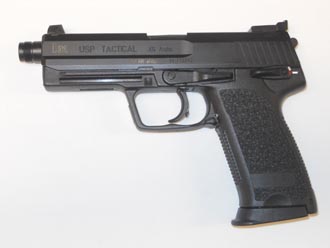
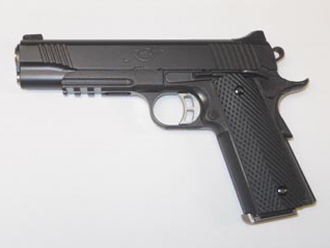
HK USP Tactical ($1,300 ret) and Kimber Tactical Entry ($1,420 ret) are both popular .45acp handguns.
All who are looking to purchase of one or both of these as 'the touted all-around defense handguns' should
consider factors with each: price, size, parts complexity / availability, weather / rough handling situations...
Perhaps other choices may be better especially if these were among the first 2~4 handguns considered...
I have often been asked which of them would I choose for flexible usage in as many situations possible.
My thoughts: Both are bulky and have .45acp recoil. However, USP Tactical will have far less weight,
less recoil, better corrosion resistance, simpler internals and their original mags hold more in a managable
frame circumference than double-stack 1911s if one was included in this single-stack Kimber comparison.
And still, for emergencies and to equip a companion; far better to grab two Glock 19s or two Glock 17s...

Oooh, now here's another A-B comparison that may have opposition or cause argumentative discussions...
It doesn't matter how "nice" a single action trigger of a 1911 may be; it requires a grip and thumb safety.
A 1911 pattern handgun is also incredibly complex, and "quality/reputable/name brand" manufacturers'
1911s will have a $1,000+ price like the Springfield EMP 9mm ($1,345 ret). A Kahr P9 9mm ($740 ret)
would be a simpler, lighter defensive gun with a better grip via actual raised checkering of plastic frame.
In the comparisons above, costs of guns aren't everything yet prices are a big factor that will become issues
with everyone sooner or later. Suggested retail prices were referenced giving a fair overview between guns.
Prices in stores and around the nation will vary as do fees, shipping, taxes and other variables in commerce.
Left-side converted bolt handle: AK modification that should never be done

Legion USA "professionally converted" left side bolt handle AK, left side view.
**Ha! I knew it! 4/3/12: Legion USA even lowered the sugg ret price on this model, in March it was $1,200+!**
This configuration 'converted by experts' is NOT a good idea. Because stock folds to the right (thus covering
cut-off bolt handle ejection side), even replacing the current bolt carrier with an original the-way-it-should-be
handle will not allow stock to fold as the stock then would interfere with handle running the bolt to the rear!!

Right side view - yes, an important protrusion is missing here on the bolt...

Non-existent bolt handle. Open view thru action because
top cover was cut for left side bolt handle: not a concern.
Non-standard ability to run bolt w/ safety on is a concern. |
 |

Oh my, perfect example of a really bad idea: what's that
just under the bolt handle? a typical side rail scope mount.
So ~ .. if someone mounted a field-expedient AK scope
on side rail mount of this rifle, uh... then can't load gun...

Above: typical side rail scope mounted on another AK. |

This Legion had VEPR/FPK type 1-300m leaf.
Usual AK sight markings 1-800m or 1-1000m. |

AKs don't have left-side bolt handles. Nor do variants such as RPKs, Saigas, Dragunovs, Valmets, Galils.
Imagine how problematic it would be if someone became used to a left-side converted bolt handle AK
and had to grab another one in an emergency. AKs should have the bolt handle kept on the right side,
and should not be able to run bolt to rear unless safety was off. Keep it original, then no problems.
Correcting the atrocious left-handed AK (will cost some $$$)

If one replaced the ridiculous left-hand converted bolt carrier to a correct, standard bolt carrier,
then the ACE stock when folded would be in the way of correct bolt carrier's charging handle!

If lowering ACE stock's hinged plate position, folded butt would then just clear the charging handle.
It would still be very difficult to run the bolt to the rear to load or clear the chamber. One solution:

Remove ACE stock and special stock support entirely, install new stock support and Vltor AK stock tube.

Rivet holes plugged after proprietary ACE stock support was removed, cutout top cover replaced with
Texas Weapons railed top cover, switch to US Palm AK grip, and Magpul MOE buttstock on Vltor tube.

Compared to the senseless Legion left-handed charging handle configuration, this now makes better sense,
with some additions and worthwhile improvements. Flash hider is Nightshroud by Manticore Arms ($40).
Smith & Wesson's SD9 - a best buy in a simple defensive handgun

10/10/10 - Shooting tests begin - this SD9 seems to be a well designed gun taking off from the S&W Sigma.
Continuing mild torture tests; but there are some points and then some issues that can be noted immediately:
Internal striker-fired handgun. Insert mag, run slide, ready. Nothing has to be decocked, safed or manipulated.
As with M&P, mag release button has too light a resistance and too short a press - mags are easily dropped-
-not good in stressful situation or proximity fight especially if opponent(s) have a hold of the gun or gun hand.
Trigger travel is similar to Glock but trigger reset distance is longer. Trigger poundage (resistance), is horrible.
Front sight is a tritium night sight, they should've just made rear sights tritium as well and charged a little more.
Slide serrations are machined for positive grasping & slide is easy-to-rack due to less-resistance recoil spring.
Slide finish seems good; minimal oiling of slide over weeks of time will reveal on this rendition of Melonite.
Full retail is only $499. Inventory price is only $475. Includes two polished stainless mags, steel nanovault.
12/01/10 - more handling and firing of same demo SD9. Resisting wiping external parts and slide.
Good: Rust hasn't started on the slide yet. Bad: Trigger pull is still heavy + mags drop too easily.

12/19/10 - more firing, this time in the rain. Salt rain of Koko Head, a wonderful test opportunity.
Only wiped exterior with dry cloth, no oil. Did not take apart gun for thorough cleaning and oiling.
01/09/11 - I would say it has proven itself. Whatever level of finish on the gun, it is outstanding.
No rust! Approx 300 rounds fired. Trigger has smoothed; easier to press when making the shot.
SD9 slide serrations were the best in positive slide retraction ability in wet conditions, but frame too slippery.
[Simply handling then firing intended defense guns in heavy rain will reveal which firearms are truly serious
best choices, designed for fighting. Otherwise, majority of gun manufacturers seem to have forgotten what
was really necessary for gunfighting and instead produce unrealistic 'range-use-only' guns that "look good".
Try it and see. Slides must be rackable in any condition, and a person's grip of the frame must be secure.
Then there are the complexities (more internal parts, more rust-able) with some guns. Simpler is better.]
3 month extended use and realistic abuse test verdict - SD9 is truly a 'best deal defensive pistol'
Taurus Judge - why a standard .38 +P revolver may be more sensible

Novel? Yes. Interesting? Yes. Good for snake country and dealing with rodent pests on a ranch? Yes.
Practical and THE answer for what advertisers/sales-pitchers claim too loosely in defense talk? Maybe not.
Still talked-up and talked-about; the Taurus Judge. Many commercial articles and ads claim greatness.
Versatility, defensive revolver prowess, impressive imagery from Taurus' own color advertisements...

Even 'tacticool' gadgetry like Crimson Trace lasergrips and certain model's ability to use .410 slugs as well...
Limited reality checks and gullibility by firearms-for-defense purchasers have distracted many from sensibility.

Come on now - would you really depend on such vulnerable wiring and batteries within halves of grip panels?
And only in Hollywood films and darkened smoke-filled rooms do the laser beams look so darn good...

First shots and tests with various shotshells at 9 to 10 yards. It's true, the patterns are weak at this distance.

Average amount of muzzle lift firing .410 shotgun loads from the Taurus Judge. Target distance 5 to 6 yards.

Federal's Game-Shok regular .410 #6 shot. Shown on white paper above and below is result of two shells fired.
Taurus' ads look neat but uses bright green Shoot-N-C targets "fired at 6 feet" on their fine print disclaimer.
This load for standard .410 shotguns prints better concentrated patterns than Federal's specialty load below.

Federal's Premium "just-for-Judge .410 Handgun" #4 shot. Sparse pattern. $15 for 20 rounds. (75c per round)
Remember, these tests are being conducted at very realistic and likely 5 - 6 yards. You don't want wide-open
patterns like these at such distances. Too many say 'it oughta discourage them...' Ok... want to bet on birdshot
if an attack occurs and a determined, aggressive individual rushes you - and all you do is pepper them with shot?
What if they have a firearm / blade / impact weapon and close the distance with momentum in three strides?

How's about .45 Colt (often referred as 'long colt') - it does have more muzzle lift, but more convincing power.

This is the budget friendly CCI 200gr Hollow Point, about $40 per box of 50 rounds. (80 cents per round)...

So for picture-proof answers to "what if?" more .410 birdshot on the target... fired two more on each paper.
Left: 4 shells game load Federal number 6 shot .410 Right: 4 shells 'special' Federal number 4 shot .410
All the shot peppered the paper even more, but proof on paper that the 'special' Fed #4 is too sparse a pattern.
Most place-of-sojourn defense distances would be greater than six feet...and even if close - will you absolutely
feel comfortable in birdshot's possibility to 'stop the threat'? I'd choose two to four rounds of .45 Colt instead!
And then for practicality: availability, economy, controllability - .38 special or .38+P - might be more sensible!
March 2011: Smith & Wesson's 'Governor' revolver on the market, it too begs the
sensibility question but even a more profound price and construction analysis...

S&W Governor Taurus Judge Ultralight
| Frame / cylinder |
Scandium / PVD Stainless |
Frame / cylinder |
Aluminum / Blued steel |
| Barrel length / weight |
2.75" / 30 oz |
Barrel length / weight |
3" / 24 oz |
| Front sight description |
Steel, Tritium night sight |
Front sight description |
Plastic, Hi-Viz red |
| Calibers |
45 ACP / 45 Colt / 410 ga |
Calibers |
45 Colt / 410 ga |
| Sugg Retail Price |
$679 |
Sugg Retail Price |
$648 |
Understanding materials cost and what 'features' a firearm might have is important to consider here.
Facts: Scandium costs more than aluminum. PVD coated stainless is a tough finish and rust resistant.
Tritium sights glow on their own power in low/no light with a half-life of 10 years minimum. They are
cylindrical inserts within sights most often made of steel, here as a dovetailed front sight in the S&W.
Now before the expected - "holy smokes the S&W looks really good in comparison to Taurus" -
- There should be the pointed question of "why is S&W's Scandium Governor way cheaper than
other Scandium revolvers that have been promoted and selling from S&W for over 10 years?"
** Sadly, as of January 2012 the S&W Governor is still not easily obtained via distributors.
why are these manufacturers always missing the easiest point to building success for a gun?
Scandium revolver prices unnecessarily high? (other than S&W Governor?) You bet.

S&W 340PD Scandium 38/357 sugg retail: $869 327 NightGuard Scandium 38/357 sugg retail: $1,049
340PD is 13oz, has crazy recoil with just 38+P loads. The 327 is 27oz, has more control, tritium front sight.
Both of these revolvers truly cost way too much even with the typical 10-20% off pricing that can be found.
Scandium or aluminum frames may keep the weight down, but will result in an increased amount of recoil!
There also is the (unlikely for most) increased possibility of frame failures with excessive loads / high usage.
Ruger's winner of a polymer snub-nosed revolver - the LCR

Ruger's lightweight compact revolver is controllable and still lightweight. Here's coverage of what was
discovered in a straightforward test including a rightfully popular counterpart, the Smith & Wesson 642.

The LCR by Ruger is 13.5 ounces, has an aluminum frame around the stainless cylinder and barrel, yet
the grip housing, trigger guard and entire back portion is polymer. Grip has a cushioned web by Hogue.
The 642 by Smith & Wesson is 15 ounces and other than the stainless cylinder and barrel, is traditional
lightweight aluminum. Grip on the S&W 642 has an exposed web backstrap style from Uncle Mike's.
As a quick and non-scientific test, three shooters tried 130gr to 158gr loads from various manufacturers in
the LCR and 642. Results were obvious - both had recoil, but Ruger's LCR had less abrupt muzzle rise and
was clearly easier to control . (Medium framed 4" on right is the proven steel S&W 66. Even more control.)

The polymer frame and air pocket backstrap of Hogue grip on the Ruger LCR added to its control.
Amazing, though not surprising. There will be more firearms moving toward polymer construction.
As an aside, a reminder is due on how much easier it is to eject spent cases from larger revolvers.

With a longer ejector rod on medium (3 to 4" barrel) revolvers, punching fired cases from the cylinder
is more positive than shorter 2" barreled revolvers. There simply isn't enough excursion to the rod.

As new products or advancements go in the world of firearms, the most prevalent will prove to be increased
acceptance of polymers - it only makes sense. As usual, there will be many who continue to doubt plastics...
As the question prevails: what are the prices of these? Using suggested retail as a consistent standard:
Ruger's LCR retails for $525. Smith & Wesson's 642 retails for $616. S&W's 4" stainless models ~$900.
**January 2011: S&W re-priced their basic 642/442 models down to a retail of $449! wow. competition?**
Smith & Wesson's disappointing polymer Bodyguard 38 revolver

Left top: Ruger LCP .380 Right top: S&W BG .380 The newest small revolver from S&W: Bodyguard .38
Lt. bottom: Ruger LCR .38 Rt.bottom: S&W BG .38 Polymer construction includes entry-level Insight laser.

Sadly, this Smith BG38 revolver (retail $510) has problems. Most concerning is ambi-cylinder release.
First one I received had a release that could be merely bumped forward and the cylinder would unlock.
Not good at all. Then it had a disappointing sight-in of printing 6 inches high and 3 inches left at 8 yards!
Insight Technologies laser is "least expensive, entry level, dim" red laser; factory aligned with sights but
adjusting the laser away from sights to "correct" sighting issue is NOT the answer nor acceptable here.
As it has a fixed notch rear sight integral to frame, sending it back for the sighting issue was required.
Second one to replace it had a cylinder release that was nearly impossible to allow opening of cylinder,
& sight-in was the same 6 inches high and 3 inches left at 8 yards! A third BG38 for testing also was off -
another customer's gun that was checked at the same time with several experiencing the same problems.
Could this be due to the now-common lightening practice of steel barrel inserts in an alloy outer shell?
Firing characteristics included noticable recoil as expected, right between the S&W 642 and Ruger LCR.
With three separate revolvers all having the unacceptable sighting issue, I am adverse to recommending
this revolver for now (December 2010). Until I witness several corrected BG38s, these are thumbs down.

After sending the second one to S&W for the second time, it has come back with the note above stating
"the enclosed handgun was sent to range for shooting left/right/high/low and passed factory specifications"
We shall see how this does for the recurring "way off" printing of 6 inches high and 3 inches left at 8 yards.
Unless some miracle was performed, the inner sleeved barrel design is not capable of being adjusted at all.
Looking to test it in January '11 and have many fire and witness the third sight-in attempt of this revolver.

01/30/11: This is how it fired. Essentially same high and left results. Still about 5 inches high and 3 inches left.
Groups at top of papers seem centered only because shooters aimed at centerline, right edge of paper.
With some difficulty of holding revolver and taking picture with firing perspective over top of revolver, here's
the image of how I had to hold to send three shots closer to the center dot of lower paper. Distance 8 yards.
This revolver is going back to S&W, for the third time and I refuse to inventory this piece of junk BG38.
I'm going to trade it for a proven model 442 or 642 and if I didn't have to pay for it I would trash this POS.
Smith & Wesson's Bodyguard .380 is proving to be a winner

For the niche market in "too-small-but-should-at-least-be-familiar-with" .380 pistols out there, here is a winner.
Facts: .380 costs more than 9mm. Small pistols have muzzle rise. No psychological deterrence with tiny autos.
These companies continue to issue only one magazine per gun, why don't they just charge for & include two?

The S&W Bodyguard .380 is the latest and has been proving to be the best yet of the top three polymer .380s.
KelTec P3AT ($324 ret) has proven track record, recent Ruger LCP ($364 ret) a more controllable offering.
Now, this S&W Bodyguard .380 ($399 ret) has the least muzzle rise and an outstanding rust resistant finish.
I don't think it even needs the weak Insight integral laser; truly a price-point addition - it would cost less if the
laser unit was omitted - price could probably be $50-$70 less, and it would be the clear winner of the three.
January 2011: demo gun above has been thru approximately 200 rounds. At 8 yards, punches groups 1~2".
With the one supplied magazine, there were only two failures to feed. No cleaning, rust hasn't appeared yet.
Will run this demo thru 400 rounds and resist cleaning internals, only wiping slide exterior after handling.
February 2011: Now approximately 300 rounds fired, some cartridges misfired, various mixed .380 ammo.
May still be in the break-in period, though it should be ironed out by now. Will continue throughout the year.
September 2011: Now approx 450 rounds fired, couple failures-to-fire but when such cartridges were
re-chambered and attemped again, they did fire. Slide finish has held up with mere wiping after handling.
Kahr Arms pistols' recurring problems

These pistols are proudly US made and inherently reliable, but their achilles heel seems to be the trigger bar.
Recurring problems I have experienced with this and two other Kahr pistols only remind me of many others'
problematic Kahr triggers failing to reset. Incidentally, when this happens, one cannot disassemble the pistol.
When the trigger cannot reset, you cannot fire a chambered round!! Kahr touted double strike ability: fail.
Looking further into Kahr trigger bar failures have revealed quite a number of similar problems nationwide.
Due to many Kahrs having problems versus numbers distributed, I don't consider them to be a first choice.
Colt manufactured / assembled AR-15s are always a secure investment

Another Colt AR-15 as unpacked from their (rather simple) cardboard shipping box with accessory pack.
Most recognized and valued Colt AR-15s are 'Government Carbine' / 'AR-15' / 'M4' rollmarked releases.
Early 1980s-1990s Colt AR boxes add bonus value to an unfired rifle if kept in unbent, untorn condition.

Then after Sept 14, 1994: Rollmarks based on 'AR-15', 'Mil/Govt/LE' increase in value if kept unfired.
A current 2011 release is a Colt-Clyde Armory limited production: 'AR-15A4 Lightweight LE Carbine'.
These represent the commercial product going full circle (1980s Govt Carbines with thin barrel profiles).

June 2011: Colt announced change of rollmarkings to eliminate 'LE' or 'Restricted Mil/Govt/LE' stamping.
Some may remember when Colt began the 'Sporter' rollmark in 1991. This year 'Sporter M4' has begun.
Naturally, omission of 'AR-15' or 'Restricted' markings puts 'Sporter' rifles in a hugely unpopular ranking.
Note absence of forge company symbols in left & right pics above of AR-15A4 Lightweight LE Carbine.

MA Tech 600m folding rear sight is a solid choice for this Clyde Armory exclusive release Lightweight AR.

Thinner barrel profile makes a lighter rifle. There's been a devious cycle "convince gun public to re-buy"
AR-15s from .575" to .625" to .750" diameter barrels, from completely heavy to M4 contour to skinny -
from 1980s thru Crime Bill's 1994-2004 thru current 2011. It just might be the perfect well-orchestrated
plan of all manufacturers and companies that market AR-15s. Seeing this 20+ years; it sure seems like it.
Most recently, influential and pricey companies - Knight's Manufacturing (SR-15) and LWRC (SL-15) -
also released lightweight-barreled ARs. It's come full circle; back to what makes an efficient fighting rifle.
Another example of Colt AR-15s maintaining their iconic appeal and value

May 2012: New release from Colt. Rollmarked 'M4A1 Carbine', the Socom 6920 is an interesting model.
Supposedly there was going to be a shift to 'Sporter' series and 'SP' serial # prefix after summer of 2011,
but (thankfully) there has been a gradual increase of 'M4' stamped ARs and this one is quite unexpected.

There is no prominent caliber 5.56 rollmark underneath model designation. Factory installed ambi-safety,
with "right-side-selector-length shorter-than-primary-left-side" configuration. Indications for 'Fire', 'Safe'.
Right-side-of-receiver stampings 'fire/safe' have been nearly non-existent on Colt AR-15s since the 1980s.

This particular rifle was a perfect example of how numerous tool marks and inclusions could be visible
on a genuine Colt AR-15 yet it'll always be worth its high market / resale value just because it's a Colt...

Holy moley, the front sight tower is almost holey... Couldn't belive this got past QC, but regardless:
the rifle will be worth the same [and maybe even have greater appeal] as another Socom 6920
simply because it is a Colt AR-15... or more notably; a 'M4A1 Carbine' without 'Sporter' stamping.


With the MA Tech 600m folding rear sight, KAC handguard and heavy barrel profile under handguard,
this could be Colt's attempt to pitch 'something different' and promote 'rifles similar to those in service'.
Forge marks on AR-15s - ultimately, who cares? You shouldn't.
Many ARs are appearing with common square / keyhole forge markings.

Oily, complete with scratchmarks too - exactly how it was fresh out of Colt box and cellophane bag.
Note that the Colt selector does not have any dash ('pointer') that could be viewed on this right side.
I have never seen a commercial Colt safety with the otherwise standard 'dash' to point to safe or fire.

This is a LE6940. C = Colt. Square forge mark on upper receiver. Keyhole forge mark on lower receiver.
Square and keyhole forge marks started appearing only this year 2011 on Colt rifles I have inventoried.
All nitpicking / concerns of too many purchasers need to stop - check out pics further down this section.

^ Also just beginning to appear 2011 - a long oval mill / machining mark on this Colt upper receiver.
Rough blemish on this Colt 6940 forged folding front sight base does not affect rifle's value one bit. ^
Agree with it or not, Colt AR-15s with particular production markings will ALWAYS rise in value.
'Colt Government Carbine', 'AR-15A3', 'AR-15A4', 'Mil/Govt/LawEnf only' are good examples.

Another Colt, a 6720R straight out of the box and cellophane bag, 'C' and keyhole marks upper and lower.
Why is upper not square forge marked like the Colt 6940 pictures? Who knows and what does it matter?

^ Square forge marks: DPMS detachable carry handle, FailSafe EXO-coated upper, CMMG upper.
Keyhole forge marks: Bushmaster lower, Bushmaster upper, LWRC multi-regional-earth color upper. ^

^ Keyhole forge marks: the upper happens to be from High Standard, the lower is from CMMG.
(Interesting to note: while most non-Colt receivers have fire/safe markings, this CMMG had none.)
Spikes Tactical and Daniel Defense have also been seen with these common forge markings;
squares / keyholes - so that means the uppers and lowers all come from the same origin!!!
Below: More pics of different rifles, some with 'A' forge marking, also seen in past years on Bushmaster.

BCM rifle upper receiver forge markings; one has 'A', another has square. Makes no shooting difference.

Daniel Defense M4 Carbine upper & lower 'keyhole' S&W M&P-15T upper 'A' forge mark, none on lower

Colt Law Enforcement carbine, 'C' mark on upper. Colt AR-15 9mm LE, 'C', 'A' forge mark on upper.
Selector has no dash indicator, no fire/safe markings. Selector has no dash indicator, no fire/safe markings.
Beretta's Model 92 variants: M9 and 92, 92A1

Two current Beretta 92 variants on the market now: M9 (closest to military issue) and railed frame 92A1.
Railed frame on 92A1 is again different from previous GSD and Elite 1A models. Won't fit same holsters.

92A1 has a slight 2mm reduced radius underneath tang of frame, allowing a much easier reach to trigger.
92A1: 3 dot sights. M9: 2 dot sights. Shooting differences by sight configurations are only psychological.

Standard 92 in background. M9 in foreground: M9-serialization, M9 markings and assy numbers on slide.
The dustcover on standard non-railed 92 has a taper toward muzzle and the M9's dustcover is straight.
Beretta's railed M9A1 and railed 92A1 comparisons

Both are railed frame models, same price. There are some differences between the two. - Beretta pictures -
M9A1 (foreground) has wide beveled integral magwell. M9A1 fixed front sight, 92A1 dovetailed front sight.
However, both models share the same type of two-dot rear sight found on the proven standard model 92FS.

M9A1 frame: aggressively checkered front and backstrap. Something so simple yet it improves firing grip.
M9A1s retail at $725; there are guns that are $1,000+ that still have 'non-effective-grip' frames.
It's 2012; all defensive guns should come with aggressive grip frames that improve controllability.
Industry stupidity - Sig handgun pricing: Stainless vs Nitron

How can 'natural stainless' Sig pistols cost more than the same Nitron-finish-over-beadblasted-stainless guns?
'2-Tone' stainless + night sighted P226 retails at $1,110. Same one black Nitron finish + nights retails $1,050.
Nitron is their rust resistant finish, black in color, applied over the same basic matte stainless slides. They rust.

Above: the brown spots on top of the matte stainless slide are not specks of dirt. It's rust. Nitron slide below it.
Also commonly seen, Sig 'contrast' standard sights shown in these pictures do discolor and yellow over time.
I don't care about some freckling of matte stainless or off-white sight squares - these are just defensive tools.

Proof that stainless can rust, more easily with the surface being bead blasted. Same problem with knives.
This one was oiled but sitting inside the factory case for several months, metal pressed against foam interior.
That is why I don't recommend matte stainless, and why I say don't leave the firearms inside foam cases.
2008's election aftermath - and again Sig disappoints

Sig handgun as it is unpacked and I check serial numbers, log it in... but wait! what's that extra sticker?!?
"One Mag Included" ?? Holy hell, that is reminiscent of the year after 1994's Crime Bill when companies
started removing one mag from the standard two magazines issued with most semiauto handguns, claiming
'not enough to go around'. Anyone remember that? So why are they doing that now? No bill even passed!

Just getting two more unpacked, these arrived in an even bigger waste-of-space carry case, NO box sticker
proclaiming "One Mag Included" - and of course, inside there was only ONE magazine. Phone messages and
email requests to Sig for clarification about this ridiculousness has yielded nothing, and no lower pricing either.
Is this temporary? Will consumers receive a second mag later? Sig can't supply two mags for defensive guns?
"So is firearm cost going to be lower to reflect this minus-one-magazine?" - I asked in several messages to Sig.
As of March 30, 2009: No reply. No responses to two emails and two attempted calls in the past 3 weeks.
To the many faithful consumers who heard me remark about Sig policy and antics before; see what I mean??
Oh, and you wouldn't want to get me started on how many errors Sig has made in orders since January '09....
Update on above antics and true ridiculousness: a letter from Sig
(can you believe this bull****? Read their well-crafted letter below!)

June 3, 2009
To Our Valued SIGnificant Dealers:
In an effort to continue an uninterrupted supply of handguns for your shelves, SIG SAUER, Inc. has instituted a program to ship our Classic pistols with one magazine. Your response has been overwhelmingly positive. Most dealers have thanked us for enabling them to better satisfy their customer's needs in a more timely manner, SIG SAUER, Inc. is pleased to help deliver profitability to your stores whenever possible.
The market demand has remained high; however, SIG SAUER, Inc. has found ways to increase magazine production. We are pleased to announce that Classic guns manufactured after June 3, 2009 will ship with two magazines once again. Inventory manufactured prior to June 3, 2009 (date is on the box label) will continue to ship with one magazine. Dealers existing inventories will not be adjusted.
Thank you for your support during these unusual and challenging times. We look forward to serving you throughout the remainder of 2009 and wish you continued success.
Sincerely,

|
Don't you just love the VERY well-written letter? Think of a dealer's standpoint as well.
How's that line 'Most dealers have thanked us for enabling them to better satisfy their customer's needs in a
more timely manner...' and what - have to explain to people that there is only one magazine?
has everyone forgotten what a spare Sig factory magazine costs / lists for!? we still pay same gun price!
*** And then that ultimatum line of 'Dealers existing inventories will not be adjusted.'
What the heck? Well SIG, demand has always been high for other companies, too - and none of them found
excuses to pull out of somewhere in apparent insulting of the dealers (so now we either throw in a second mag
at OUR cost to make sure existing inventories sell, or suffer languishing stock as consumers wait for inventory
manufactured after June 3, 2009 that, as stated above, will be "shipped with two magazines once again.")
Since January 09, though there has been a major increase in demand for all in the gun industry, and even being different companies; operating systems and manual of arms - Glock, S&W, Beretta, Springfield, HK -
none of them ever altered their issuance of two mags per handgun if it already was standard issue.
Folks, when a braggingly large company sells hundreds of pistols in a few months AT THE SAME COST,
omit one magazine, expect dealers to sales-pitch the gun (and gun's value), not supply make-up magazines,
and then find some claimed way to "increase magazine production" - they are making $$$.
November 2010: after all nonsense of SIGnificant dealer purchasing requirements, failed product promoting
& ordering procedures drawn up by management, hyped sales pitches by Sig reps (and many have left Sig):
the standard distribution system that has always worked - have Sig handguns at distributors and then dealers
just call up and order what's in stock - is what it is returning to: 2 day order fufillment instead of 2-4 weeks+.
If consumers could only see all the desparate emails I receive from Sig: promotion this, discount that,
closeouts and 'special production models' that obviously are to get rid of overstocked parts or guns...
Typical backorder from Sig - was on backorder for 4+ months...

Here is one of the recent Sigs received - P226 Elite Dark. Box stickers: Date: July 31 2009. Two mags.
They claim this Elite (and virtually all their product) is in 'high demand'. Then make more of the dang things.
There aren't thousands of these being 'demanded' and subsequently being paid high prices for by consumers.
Dealers and consumers should not have to wait 4 months to get something that is still a mass-produced P226.

The Elite Dark and several 'new models' have a short trigger. Due to different shape, geometry and leverage,
the thinner "short trigger" (rt pic) has a heavier percieved trigger pull than the standard trigger. Very sad.
Just because a handgun like the Elite retails for $1,200 doesn't mean it is the ultimate handgun for all time.
Two good points on the Elite series is that the trigger reset distance is short and the aluminum grips are slim.

However, if one is not aware of mag seating pinch hazard, this is what happens with overhanging grip panels.
Imagine this happening when briskly slamming home a magazine into the P226's mag opening! Ouch is right.
Oversized carry cases - why?!?

For more than 10 years these Sig handguns have been shipping in oversized, bulky carry cases.
Not quite ready to accept extra mags or boxes of ammo unless foam interiors were altered or carefully cut by
consumer, these still end up being stored or tossed by most and guns transported in more efficient range bags.
Heck, this all could be just my opinion, yet it sure seems to be realized now as they changed over to these:

Size-efficient, less cost in shipping the guns and compact enough that they could be carried in or out of bags.
Sadly, the manual has been reduced in size, and the text inside is very small. Try to read one and you'll notice.
They could have kept the same manual. The new manual also omits some important reiterated safety warnings.
Straightforward comparisons on two modern production 1911s:
Kimber Super Carry Pro and CZ / Dan Wesson Bobtail Valor
While there are never-ending comparisons being made on 1911s or some useless '__vs__' article about
'which defensive handgun/rifle is best' (but then compares firearms that have different operating systems),
the following segment will be a blunt, factual comparison between two 1911s in the same style/category.
Scathing points will also be made on 1911s in general. The truth will upset many.
I too have 1911s, I just don't claim them to be the final answer for everything.
Bottom line? There's a clear winner if comparing the two, winner exemplifing "you get what you pay for."

^ Kimber's 4" barreled full-size aluminum frame offering retails at $1,530. All its key small parts are MIM.
CZ's 4.25" barreled full-size steel frame has a retail of $2,040. All key parts on it are forged, not MIM. ^
Either may be found at some $200 discount, yet at $1,300 and $1,800 one still should recognize differences.
Both are 'worth their respective price bracket' and are 'wonderful 1911s' - but are they 'ultimate' carry guns?

Both are produced with angle-cut 'bobtail' frame that was most commercially popularized by Ed Brown.
Reducing unecessary pointed butt of frame for concealed carry with 1911s, it also reduces perceived recoil.
The Kimber has ambidextrous safety levers, CZ does not. Both have night sights and rear sights are ledged
to provide solid hook for emergency racking of slide. Serrations on both slides are not quite secure if wet.
Blued steel slide of Kimber has rust-resistant coating, stainless steel frame and slide of CZ also has coating.

Here's where it gets blunt - truly blunt. Kimber's frontstrap has a pointless artistic-for-nothing design that
has no worthwhile grip. Look at many production aluminum framed 1911s' frontstraps. They often cheat
using a generous border of no-texture at the area between trigger guard and start of texture/checkering.
CZ Valor has bonafide 25 line-per-inch checkering that provides positive secure grip whether wet or dry.
See it either way you want - I would favor better grip provided by 25 lpi checkering over any fancy design.
Covering up / making safe zone of machine work never beats higher-cut checkering on even pricier 1911s.

Wood looks nice. Fragile, susceptible to everything: impact, prolonged exposure to water / oils / solvents.
G10 (glass woven fabric + epoxy resin binder formed under high pressure) is near-impervious to elements.
All guns with grip panels suffer possibility of loose grip panels / losing grip screws / temptation to buy grips.

Are you kidding me?? The nearly invisible design crap on mainspring housing of Kimber Super Carry Pro
offers zero in indexing or grip for center palm of firing hand. CZ Valor has their proper 25 lpi checkering.
When will gun manufacturers realize defensive fighting guns must have secure grip on frames and slides??

Important small parts: slide stop, thumb safety, hammer, grip safety. Simply put, Metal Injection Molded
parts are cheaper to produce and weaker than billet steel. Unless one experiences serious parts breakages
the majority of consumers won't believe how important it is to spend a little more on such important parts.
I have had several MIM parts break on a few 1911s of mine - two didn't even make the 500 round mark.
Here's a glaring truth: if there is really such a serious need for a concealed carry / 'the worst situation' gun -
use simple internal striker-fired handgun like a Glock. Costs less, less parts, simpler, easier to teach others.
You wouldn't hesitate to run the gun hard, get it dirty or wet, bash it, beat it up, no grip panels to get loose.

Bushingless bull-barrel design of popular 4" barrel 'Colt Commander emulating' Kimbers look good in ads.
Combined with a full length guide rod, it complicates routine disassembly versus standard short recoil guide.
Must use wire disassembly tool (paper clip can work if you lose yours supplied by Kimber) for such design.
CZ was smart to use proven Colt's Commander design: stick to simple barrel bushing design disassembly;
avoiding full length guide rods that do not improve accuracy or some ridiculous claim that, in the end, has
nothing to do with scoring life-or-death hits that would be decided within a frightening 1-3 paces/seconds.

If taking the compressed recoil spring assembly apart for the Kimber Carry Pro, parts count for both guns
on field-stripping is nearly identical. Both as 1911s have even more tiny parts that would be revealed only
when detail stripping guns' slides and frames. Again, remember that more parts equal more to go wrong.
Also remember range use has nothing to do with operating considerations of every worst case scenario.
Two magazines should be minimum standard issue with 1911s over $700
[the hell with Kimber already, and every semiauto handgun should be shipped with a minimum of 2 mags!]

Remington base R1 1911: two standard blued mags Springfield Milspec 1911: two standard blued mags

Dan Wesson Heritage: two Checkmate stainless mags Sig Sauer basic 1911: two Checkmate stainless mags

Kimber Desert Warrior and Ultra Aegis II (among so many other models from Kimber): one magazine.
From basic Kimber 1911s around $800 to special 'ooohh' this-and-that special $1,500+ models; 1 mag.
Sure, those in the know will often set aside standard issue mags and just get Mccormick / Wilson Combat /
similar performance magazines, but it is the 'issuance of only one mag' principle that is being questioned here.
Pistols should include 2 mags! In fact, every magazine-fed firearm should have a minimum of two magazines!
Rifles, shotguns, handguns - which company will be the hero and set a new standard in the firearms industry?
Understanding decocking lever on Sig and decocking tab on HK

Sig system involves decocking lever on left of frame. HK system involves decocking tab at rear of slide.
Aluminum frame Sig P229 night sights: ret $1,050. Polymer frame HK P30 luminous sights: ret $1,050.
Neither has any attribute substantial enough to be noted to explain such insane suggested retail prices.
Both come with two magazines & plastic carry case. HK sights are luminous only, not tritium like Sig.
Similar aluminum framed Beretta 92s retail approx $650. Polymer framed Glock models retail $600.
Apparently, company name and decades of mysticism creates an acceptance of high prices for certain guns.

Sig: utilizing example of a left-hander, the trigger finger becomes controlling factor for decocking handgun.
HK: As decocking tab is at rear of slide - left of hammer - it is easier for right-hander to decock hammer.

Sig: Left-handed shooter brings lever down simply by using trigger finger, pushing decocking lever down.
Sig: Right-handed shooter in two-handed grip would push the lever down with left (support) hand thumb.
HK: Right-handed shooter thumbs the serrated tab down and hammer will lower down into hammer slot.

Hammer postitions on pictures above show the Sig and HK hammers in 'down and decocked' positions.
These will have traditional double action longer & heavier first shot trigger pull, then go into single action.
Neither have manual selectable safeties. No defensive handgun 'needs' such items. Safety is by gun user.
Bottom line - it does make it tougher to be uncannily proficient with these; and in an emergency situation,
imagine attempting to explain to someone (who isn't gun comfortable) all the above in 10 seconds or less
- making sure they have trigger finger discipline and muzzle direction discipline... Simpler guns are easier.
Quirks of Springfield XDs - showing clear: mag out, lock slide to rear

The grip safety in the XD design must be depressed in order to allow the slide to run fully rearward,
while a strong push upward on slide stop with thumb will lock slide to the rear.
(while being conscious of muzzle direction and keeping finger off of the trigger!)
Recoil spring tension in XD is heavy; this requires one to get used to the recoil spring's resistance
when locking XD slides to rear. Springfield Armory claims this grip safety makes this gun 'safer'.
Shouldn't the operator be the ultimate answer to safe firearm handling??
The truth is, the XD trigger has a rather light resistance to being pressed, of which
without the grip safety function, could result in inertial firing of the gun if it was dropped.
Therefore, XD pistols had to have this so-called 'safety feature'. It was a must, not design ingenuity.
Comprehensive photo comparisons: Springfield XDs, XD-Ms, Glocks:
balance of handgun size and practicality - the arms race continues

Three frame and slide sizes for current model Springfield XD-M handguns. Width of XD-M45 vs Glock 21SF.
Slide / frame thickness is actually same for both XD-M and Glock 21 even if XD-M slide narrows toward top.
XD-M models boasted improved 'shorter-trigger-reset' than earlier XDs. Why didn't they engineer that before?
XD-Ms did improve the frame texture and slide serrations have increased grip traction over the standard XDs.
Of course, price of XD-M is higher than standard XD. (retail on base models: XD-M 9mm $697. XD9 $549.)

Side views of XD-M45acp and Glock 21SF. Simple truth shown in picture: XD-M45 frame is taller.
Taller for what? To have a magazine intended for 13 rounds. Previous XD45 model same capacity.
Glock 21 always had 13 round capacity. All have 10 round versions. Therefore: most practical is G21.
Picture-proving fact: Glock still has a closer grip-to-bore relationship especially visible at trigger line.

XD-M45 & XD-M9/40 full height mag w/ sleeve. XD-M9/40s: one w/ tall mag, one w/ compact magazine.
The buzz surrounding the XD-M was always focused on mag capacity. 19+1 for 9mm, 16+1 for .40 caliber.
Funny how so many contradict themselves talking up how much they and others need to hit what they aim at
& practice way too much of marksmanship, almost idolizing the nirvana of printing perfect groups on targets.
The reality of any violent gun use for defense will require defendant to not stay in the same place - MOVE! -
so how will countless rounds spent in peacetime range sessions help in such dynamic and shifting situations?
I don't even need to get into topic here of how a grip safety is a bad idea, yet most will never get involved in
uncomfortable and unconventional training elements where it goes beyond "..have a perfect grip on gun.."

XD-M9/40 compact shown aside Glock 26/27. The XD-M compact still requires a base extension if comfort
was the intended goal for range shooting. Dare we say comfort and range shooting for a much more serious
application in future unpredictable and violent situations where a compact carry gun just may save a life.
G19 in third picture above has a frame height that still proves to be an ideal height for most hands and has a
near-perfect size, balancing important attributes for concealment and control, without needing mag extension.

XD-M9/40 compact shown aside Glock 19/23. XD-M9/40 compact with full height magazine and sleeve.
M is unnecessarily tall in height. Those who truly understand every aspect of consistency in (what should be)
required levels of training and serious civil / criminal prosecution possibilities would be thinking twice about
the claimed superiority of XD-M compacts having a switcharoo compact mag and tall mag-that-needs-sleeve.
The predominant ego-driven mass-advertised concept of having a 13+1 9mm or 12+1 .40cal compact then
slamming in a 19+1 9mm or 16+1 .40cal full height mag for home defense among the righteous chest-beating
concealed-carry know-it-all crowd is plain stupid, and can get many into more trouble than helping a situation.
For required 10 round capacity locales, the obvious is even more evident: Why buy such a gun? Less is more.

Full height XD-M aside a standard XD. If resorting to sleeves on magazines, why not offer one for XD mags
that still lock in place inside the XD-M? Oh that's right, need more bullets! And can sell more different mags!
Yes I'm being sarcastic. (Standard XD 9mm: 16 round magazine. Standard XD .40cal: 12 round magazine.)
While there are 10 round magazines for standard XDs, there are none for the XD-Ms except XD-M45acp.
The compact XD-M 9mm or .40cal configuration can use XD compact's 10 round mags and still fit flush, but
for the full height XD-M 9mm or .40cal, there are added costs to block tall mags to 10 rounds. Not worth it.

Standard XD 9/40, Glock 19/23. Glock has closer bore axis, efficient frame height, excellent track record.

Standard XD 9/40, Glock 17/22. Again, why argue what simply makes the most sense? Ah, the undisputable:
Glock is still the simplest on the market, least number of parts and incredibly good fighting gun's trigger from
back in 1983 - a certain resistance to press, short reset & trigger return - which negates need for grip safety.
Any gun can do; what one chooses needs to be trained with - beyond what the masses do. -Training link-
Techniques that make the difference...
Loading and chambering ammunition in a semiauto handgun
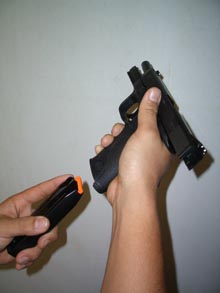
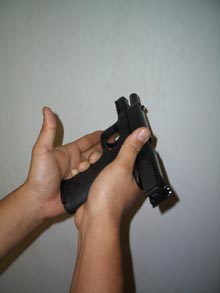
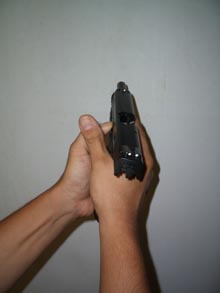
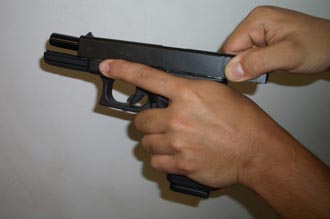
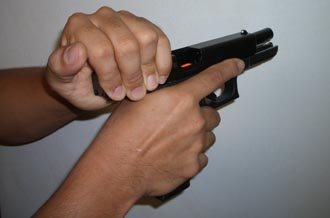
* loading sequence: index finger points the way to insert mag into magwell, palm will seat mag positively, support hand thumb decisively presses down slide release, complete proper two handed grip of handgun.
Even if the strong hand thumb has a percieved reach to slide release, a positive 'first time, every time'
release can be accomplished by support hand thumb, especially when having to deal with various pistols.
Different pistols' slide releases may have varying locations fore or aft for the slide release (and some don't have any at all).
>Do not let yourself or anyone else complete a two handed grip with support hand thumb ending up behind slide of auto!!
Another reason why using the support hand thumb to decisively press the slide release works well - give it something to do
and position alongside the frame, and not wrap it behind the slide where the outcome could be bad (slide striking thumb).
If slide stop is too small or out of reach, a simple insert of mag and tug of the slide will send the slide forward successfully -
better than trying to swipe the slide stop repeatedly or trying to maintain a firing grip AND hit the slide stop with right thumb.
'Positive insert and rack' movements are the same as what is needed to clear 'failure to feed' or 'failure to extract' malfunctions.
Efficiency in packaged ammunition - and how many do not know ammo
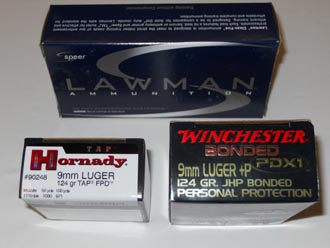
Foreground: two boxes of 'performance' HP defensive ammunition - Hornady & Winchester. Back: 50rd FMJ.
Hornady's smaller box contains 25 rounds, $23.95/box. Winchester's larger box has 20 rounds, $21.95/box.
Classic example of 'bigger not always better' and Hornady is still one of the best deals in defense ammunition.
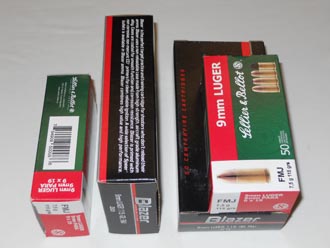
Sellier & Bellot 9mm in close-packed 50 round boxes exhibits the best efficiency for storage space concerns.
Once again, American marketing (sales pitch) thinking brings about 'bigger-waste-of-space' boxes for ammo.
Blazer and US manufacturers will probably continue producing waste-of-space larger-than-necessary boxes.
Now Sellier & Bellot and Blazer ammo are cheap, consistent 9mm FMJ ammo at only $13~$15 / 50rd box.
They aren't 'dirtier or cause malfunctions' any more than other mfgs. Stubborn shooters will pay $18 or more
per box for other brands of 9mm and the majority that try to save brass for reloading never get around to it.
If going to a static range for firing a defensive handgun, shoot with a purpose and be done within 50 rounds.
Simple answer to the caliber debate and stopping power
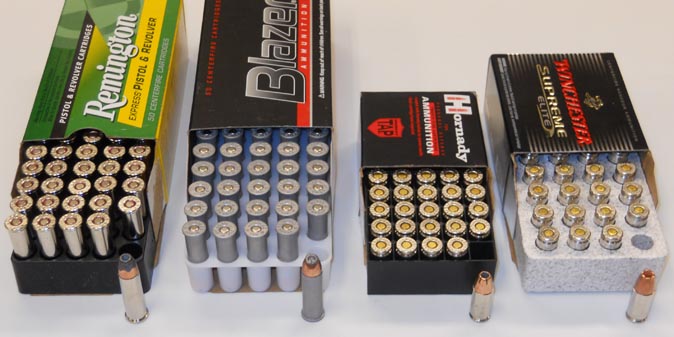
Why do so many tell me how much they know guns, have preferences for this or that brand of hollowpoint,
and when I hand them a box or two for purchase, they proceed to open the box and stare at the bullet?
Nothing screams rookie louder than that example. In the end, what does it matter how the projectile looks?
Use hollowpoints when available, hit what must be hit until threat is no longer capable of further action.
Missing a shot is still a miss. In the end it simply does not matter what caliber missed or hit a vital area.
Horrible yet simple truths: May need more than one shot. If chest hits don't work, send bullets into the face.
Shoot several into the neck as well. 9mm, .40cal, .45acp, .38special, even .22LR - will do serious damage
and caliber won't matter at that point when considering the important and fragile anatomy in the neck area.
Abuse tests of AK magazines

Disclaimer: I wouldn't do this to your mags or recreate this test. Yes, this type of abuse goes overboard but
proves that well-built mags can take quite the beating and that you can't beat common steel magazines!

Newest entry into the US-mfg polymer AK mag market: US Palm. Steel cage incorporated at mag catch, but
does not continue upward thru the feed lips at top of magazine. Seems like a solid quality polymer magazine.
Vented follower allows debris to go in or out. Sealed mag box with some type of corrosion-resistant spring.

Most critical area is feed lips and latch area of these magazine types. (Examples: AK, M14, FAL, HKG3)
Latch seems solid, yet how about absolute strength when top of mag or feed lip area is struck?

As stated, this is a serious abuse test. 3 violent throws of mag onto rock shattered top left of mag.
Not bad; other substandard polymer AK mags shatter after only 1 half-speed throw onto rock or concrete.

It took 5 violent throws to mash one side feed lip of a steel AK magazine. The steel mag is repairable.
Simply bend feed lip back out to correct height. The other mag - well, it's done for. These are just the facts.

US Palm mag on left fed rounds from the right side non-shattered feed lip; but must be tossed. Irreparable.
Standard steel mag on right fed rounds from left side feed lip; bent-in right side was repaired later by bending
it back up to correct height (it was mashed inward), allowing rounds to be fed properly by bolt into chamber.
Bottom line: Steel feed-lipped mags (all-steel mags with solid latch and mag wall thickness) are still the best.
I would still use US Palm AK magazines but depend on the basic steel ones as the most rugged first choice.
August 2011: Too many quality control issues Century Arms GP/WASRs

Every now and then, there just has to be a lemon... In 20+ years being in the firearms industry, the 'lemon'
rarely happens - yet notably from 2007 thru Aug 2011, there have been increasing QC issues with these.
What I have to go thru as a dealer each time to help customers send back GP/WASRs is unbelievable-
customer service reps instruct me to refax my Fed Firearms Lic 'to prove I am a dealer' then they try to
pass the buck and have me talk to a gunsmith 'to see if the problem could be resolved that way' before
giving me a return authorization number and setting up a prepaid return shipment. (all problems to date
that occured were crucial enough that I had to/decided to help consumers and contact Century Arms.)
I asked what they'd do for a consumer directly- they just call for return authorization and get it shipped back.
And I thought I was helping out customers...instead it seems I get penalized for trying to stand up for Century.

This particular AK (GP/WASR Romanian) just wouldn't cycle properly even after 50rds were attempted.
Check the gunsmith report! If these rifles were honestly test fired from the beginning before being shipped
to distributors, they would have caught this problematic WASR. Their remedy: install oversize gas piston!
When oversize gas pistons become the answer to failure-to-cycle problems, there are other root issues!!

How dare they enter words describing something I did not do! I did not refuse to send in mag(s)!
No one told me to enclose mag when sending rifle for service. They claimed that because I had not sent
in any magazine, the rifle sat on the side for several weeks as I still had not sent a magazine per request.
I pointedly asked why does anyone need to send magazine to merely test fire a rifle that (regardless who
assembles it) should function & feed virtually all AK mag types when it came to near-perfect simplicity
of the AK and is supposed to accept any 7.62x39 caliber AK mag whether US or foreign manufactured.
And what proves one mag over another? Will a Century Arms gunsmith scribe or mark the tested mag?
What happens if a consumer gets a single misfeed with another mag later - is it rifle, or magazine's fault?
Sounds stupid yeah? "oh, Century Arms AKs might not feed right or at all with some mags out there..."
I told service rep- why don't they just say basic disclaimer: 'Century recommends use of steel AK mags.'
-most whining complaints solved. (Original Bulgarian 'circle 10' or US Palm are best for polymer mags.)

Another Century GP/WASR-10/63 rifle exhibits canted front sight tower, thus requiring extreme front post shift.
These should not even have left the work table / build room / after quick test fire, let alone quality control check.
Even if one was able to move front post to a point of making center hits at medium distance (50yds), this is very
poor assembling-and-approve-to-ship decision by any company. I have seen this problem about 1 in every 3.
So, as of August 2011, I will no longer order GP/WASRs for active inventory. I still will use my GP/WASRs...
* Never had (higher price $700~$800+) Polish pattern Century AKs or Arsenal AKs exhibit these problems *
Abuse tests of AR-15s and a tough magazine

Dirt and sand purposely poured into top of Cammenga magazines...

... even dragged across ground and scooped right into top opening...

Sand and particulates drain right out of the opening on bottom of Cammenga magazine.
They all fired fine, no stoppages. Their website has more video tests of this amazing magazine.

2 days of June Shooting Sports Fair thru weekends of accumulated firing, plus some in Suarez course:
No cleaning, easily 600+ rounds of gray steel cased Wolf, green steel laquer cased Brown Bear, and
300+ rounds mixed brass cased ammo, no malfuntions on extraction or feeding into the chamber.
Dirt, debris, laquer and carbon - it still cycled fine. I had no malfunctions, no catastrophic problems -
just a dirty rifle. Bolt and carrier took same amount of time to clean whether 100 or 1000 rounds.

Rifle above and below has fired 500+ rounds over an extended 8 months with majority being Wolf ammo.
I refrained from cleaning it and it fed all kinds of US brass cased and various types of Wolf steel cased ammo
without any problems. Naturally, that proved the chamber dimension is favorable (not a tight match chamber)
and proves regular ARs feed and fire just fine. This one has an Olympic Arms lower and Bushmaster upper.

This went thru dirty dusty and rainy conditions and was fed all types of bullet profiles and brands of ammo.
With all the grit and carbon fouling, this gas impingement rifle worked just fine. Your defense/working rifle
needs to feed and fire everything on the market. If it doesn't, it simply cannot be considered a fighting rifle.

The above fouled and clean pictures of a bolt and extractor from a STG 556 rifle are just too good to pass up.
Hundreds of rounds were fired, packing extractor with carbon and powder crud. Still worked and functioned.
Regardless of the .223 / 5.56 rifle model, these keep going! After all, these have been proven military designs.
Military design rifles don't need babying! When they get dirty and one has a chance to clean them, then do so.
Gas piston rifles and the truth on carbon fouling
FN-FAL

Above: where gas piston rifles still get dirty! not as much in the chamber yet carbon has to go somewhere!
FN-FAL type rifles have an exit for carbon gases right under the handguards. Piston and plug gets carbon.
A proven operating system since 1947, gas system only requires a piston rod with spring and piston plug.
POF-USA

POF gas piston system: only 3 parts. Piston plug, piston, piston rod. However, lose any part, rifle don't work!

POF-USA's rifles still have carbon that builds up in the front sight base assembly; system is much like FAL.

POF-USA's awesome NP3 and nickel surfaces reveal very little fouling, just some carbon on bolt face, lugs.
This rifle was also brought out to the Shooting Sports Fair and for 2 days had 400+ mixed rounds thru it!
That included steel cased Wolf, laquered steel cased Brown Bear and zinc plated steel cased Silver Bear.
Minimal crud in upper receiver and on bolt assembly wiped off easily. Not so underneath the handguards...

What happens if no one cleans gas piston housing / entire front end under handguards thoroughly and promptly
^that brown crud is rust growing on piston housing! ^carbon, lead deposits visible in barrel flutes
This is after 600+ rounds were fired over another 4 months, then letting rifle sit uncleaned for 7 or 8 months.
LWRC

LWRC requires 5 parts in its piston system. Lose any one part, rifle does not function. Not so exciting.

One example of carbon fouling with LWRC's gas piston system (why did they design this to vent there?!?)
Two pics above: M6A3 model's adjustable gas system. Adj knob is now stuck. Pics below: standard system.

LWRC's piston system blows carbon gases right under and thru these aluminum handguards. Still gotta clean!
Their piston system is a series of sections and still need to clean them and this area; if not, rust will develop!

This is after approximately 500+ rounds of steel cased Wolf, Brown Bear, and some brass cased ammo.
Proves that there still will be crud if you fire these guns! Little less at the chamber area, but still gotta clean!
Great fact though, is I put out this LWRC at the Shooting Sports Fair from Sat AM to Sun PM (2 days)
and no cleaning, no malfunctions. I did not even do a customary initial cleaning or prelube of the rifle...
How costly some 'new' rifles can be - and their designs are nothing new
FN SCAR 5.56 in Flat Dark Earth or Black *prepaid order price $2,550*

Fabrique Nationale's long awaited Special Forces Combat Assault Rifle is now readily available.
All prepaid orders must be paid in full to get the discounted price. FN SCAR retail price $2,995.
Since I don't sales-pitch or try to convince people to buy 'every new gun or gadget under the sun',
I see no point in trying to impress consumers with loading up inventory of such high priced rifles
like SCAR and ACR, HK416s, LWRCs, POFs, then have a resultant pressure to move product.
Prepaid order prices offered at discount, no inventory loading needed, consumers can get deals.
Is this rifle really worth the price at full retail or even when discounted hundreds of dollars below retail?
This won't do anything different than a basic $1,000 AR-15. Both will put bullets consistently on target.
Facts to note: All three rails up front have sharp corners; right where hands and fingers would go.
Side-folding retracting stock seems very fragile - no way one could bash anything with it or it'll crack.
This rifle has one good attribute; it is super light and saves lots of weight up front versus Bushmaster ACR.
Many shades of flat dark earth and tan/brown is great on this SCAR; sadly they merely paint 2/3 of mag -
does FN fear many armchair commandos will whine about tan paint scratching off the top 1/3rd of mag?

Monolithic receiver on SCAR and Bushmaster ACR is smart idea; but SCAR has no quick-change barrel.
Operating bolt carrier handle reciprocates during firing cycle. User-induced malfunctions are totally possible.

All major components shown field-stripped; gas piston system is seen up front by gas block/sight mount.
Gas piston plug and piston is very small - tremendous problems will result from losing them. Rifle won't work.

Basic sub-assemblies; less major components since no handguard or quick-change barrel as ACR.
Stock group and trigger/grip assembly fits together then locks with receiver with one crosspin.

Folding stock has fragile adjustable cheekpiece, stock extending arm feels like it'll break with rough use.
Positive point: folded stock locks with protrusion from right side of receiver independent of stock length.
Bushmaster ACR 5.56 enhanced *prepaid order price $2,340*

2012: More than five years since first announced in spring of 2007 and delays in being released each year,
ACRs still float in and out of availability. Basic fixed stock models were at an ideal medium length-of-pull
(like a retracting AR at mid-position) and telescoping/side folding stock version has a railed handguard.
Is this rifle really worth the price at full retail or even when discounted hundreds of dollars below retail?
This won't do anything different than a basic $1,000 AR-15. Both will put bullets consistently on target.
Tele stock model in Black or Coyote Brown retail $2,699 prepaid order price $2,340.

Facts to note: Enhanced models have very heavy front ends; machined rail forend adds too much weight.
The standard configured rifle is already too heavy of a rifle as it is. Lightweight profile barrels planned.
Magazines can be released way too easily. Mere bumping of mag release button will eject magazines.
Quick-change barrel system is a winner; but M4 contour barrels are unnecessarily heavy for this rifle.

Tele stock models have a side-folding retracting stock and a machined railed handguard up front.
The effective AAC flash hider is a plus over the standard configuration's A2 birdcage flash hider.
Now, (2011) they finally offer a variant with desired side folding stock but keep basic handguard.
Nix heavy rail forend. Basic w/ folding stock Black or Coyote retail $2,490. Prepaid order price $2,150.
Bushmaster ACR 5.56 basic *this version has been updated with side-folding stock*

Basic fixed stock models were at an ideal medium length-of-pull (like a retracting AR at mid-position).
Basic version now has standard handguard and is updated with side-folding stock.
Basic w/ folding stock in Black or Coyote Brown retail $2,490. Prepaid order price $2,150.
(2011) Bushmaster finally came to senses and now distributors don't inventory fixed stock models, listing
"basic with folding stock" models black or coyote. Why didn't Bushmaster offer these from the beginning?

Best (yet costly) attribute of this gas-piston rifle is undoubtedly the tool-less quick change barrel system.
The ACR's gas piston components are less likely to be lost as they are a sizable spring, long rod & plug.

The ACR uses proven designs of prominent military rifles (most notably the AR-18 from 1963).
Armalite AR-18 has influenced very similar bolt and gas piston designs over the years such as HK's G36.

Gas piston design is nothing new; M1 Garand (designed 1932), Sturmgewehr (1944, predecesor to AK-47),
FN-FAL (prototype 1947). Components of the ACR prove to be very modular and easy to work with.

[Different stock groups and handguards can be installed; release date unknown for calibers other than 5.56]
- as of August 2012: Still no common availability for different barrel lengths or 6.8SPC bolt/barrel kits -
- the ACR has only proven to be a costly rifle with a non-existent supply of caliber/model components -